Research
principles and applications of dynamics in systems and synthetic biology
Research Overview
Systems Biology
Cells operate in fluctuating and unpredictable environments. Their responses—fast, slow, or buffered—depend on the timing, frequency, and amplitude of environmental signals. Traditional steady-state experiments reveal molecular components but often obscure the dynamic rules governing real-time cellular decision-making.
We study these principles using:
- Dynamical modeling of gene regulatory networks
- Nonlinear system identification from time-series data
- Controlled, time-varying environmental perturbations
- Analysis of stability, robustness, and adaptation
- Synthetic genetic circuits to probe dynamic behaviors
By combining real-time measurements with computational inference, we aim to uncover how cells process information and adapt, turning systems biology into a predictive, quantitative discipline.
Synthetic Biology
Our lab builds genetic circuits to test and exploit cellular computation. Key contributions include:
- Robust oscillators that maintain precise timing under noise
- DupOri adaptation circuits that regulate replication initiation
- The synchronized lysis circuit for controlled population-level dynamics
These systems allow us to study feedback, adaptation, and collective behavior while providing platforms for engineering cells with predictable functions.
Microfluidics Design
We design microfluidic platforms to control cellular environments with high precision. Our research includes:
- Gradient-generating chips for studying chemotaxis and dynamic responses
- Organ-on-a-chip and microphysiological systems to replicate tissue-level processes
These tools enable quantitative experiments under reproducible, time-varying conditions, connecting environmental inputs to dynamic cellular behavior.
Medical Therapies
We develop systems and synthetic biology strategies for therapeutic applications. Highlights include:
- DNA biosensors for early detection of colon cancer
- Chemotherapy delivery using bacteria programmed with the synchronized lysis circuit
- Adaptive laboratory evolution (ALE) to optimize bacteria for survival in the tumor microenvironment
These projects integrate engineered cellular dynamics with translational goals to improve precision therapies.

Environmental Biotechnologies
Our lab applies synthetic biology to monitor and remediate environmental challenges. Key efforts include:
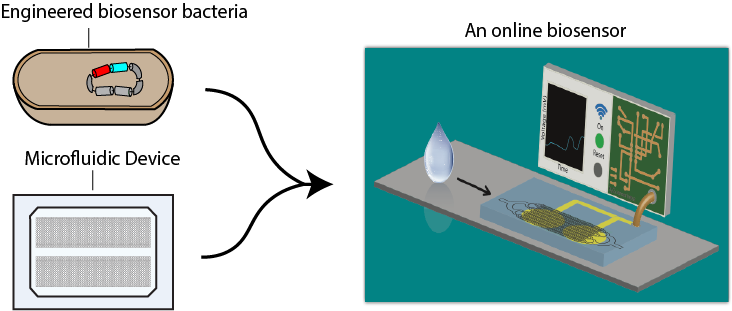
- Biosensors for water quality and heavy metal detection
- Engineered circuits for robust signal processing under variable environmental conditions
By combining dynamic modeling, circuit design, and experimental validation, we optimize microbial performance for practical environmental applications.